Breeding Management
The Animal Facility provides guidance on best‑practice breeding strategies for genetically modified strains. We offer colony monitoring and genetic background testing, and we follow quality‑assured procedures to minimize the risk of genetic drift.
For questions or specific requests, please contact our Laboratory Animal Breeding QA/Consultant, Karina Vestergaard Nielsen.
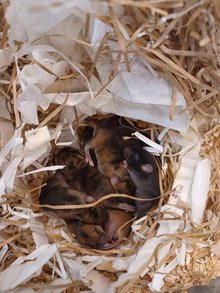
Colony management and breeding of transgenic lines
Our laboratory animal caretakers are experienced in maintaining mouse and rat colonies and in breeding both simple and complex transgenic lines. Breeding strategies are planned in collaboration with the PI, and adjustments are made proactively as the colony develops.
Pooling of animals
To safeguard genetic integrity and maintain manageable colonies, we do not allow pooling of offspring from different strains. Only littermates or offspring from the same strain may be housed together. Mixing strains introduces a risk of misidentification when establishing breeding pairs.
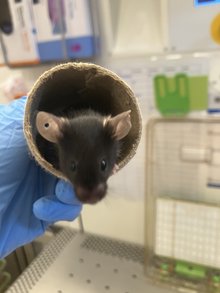
Best practices for minimizing genetic drift
We follow established best practices and internal quality‑assurance procedures to ensure genetic stability, maintain strain integrity, and minimize the risk of genetic drift.
Genetic monitoring
The Animal Facility collaborates with TransnetYX, a provider of genetic monitoring services.
For inquiries, please contact our breeding consultant, Karina Vestergaard Nielsen, at karinavn@biomed.au.dk.
Guidance on advanced breeding, genetic drift, backcrossing and more
We recognize that genetic drift is a significant concern when working with inbred and transgenic mouse strains. To support stable colonies, we are establishing a structured maintenance and backcrossing program for our rodent strains. These efforts help ensure genetic integrity, reduce drift, and maintain reproducible research models.
Our Laboratory Animal Breeding QA/Consultant, Karina Vestergaard Nielsen, has expertise in breeding strategies and genetics and is available to provide guidance whenever needed.
We follow the breeding and colony‑management guidelines published by The Jackson Laboratory (JAX). For an accessible overview of backcrossing principles and strategies to avoid genetic drift, you can refer to JAX’s blog post on backcrossing.
We also use dedicated strain nomenclature in accordance with the standards set by the International Committee on Standardized Genetic Nomenclature for Mice. If you would like to learn more about applying correct and unambiguous genetic nomenclature—or take a short interactive course—you can visit JAX’s technical support page on genetics and nomenclature.
In addition, we offer advice on selecting the appropriate genetic background for transgenic strains, whether for backcrossing or for use as experimental controls. If you are unsure of the genetic background of your strain, we can assist with genetic monitoring in collaboration with TransnetYX. Further details are provided above.
For questions or support, please contact Karina Vestergaard Nielsen at karinavn@biomed.au.dk.